Microsoft and Alphabet Both Post Big Cloud Growth, but Investors Read the Spending Differently
Azure grew 48% and Google Cloud 103% in the quarter. What each company reported on 28 October, and why free cash flow, not cloud growth, split the reaction.
Two of the biggest cloud businesses in the world reported results on the same evening, and both of them grew faster than most companies ever do at that size. The market’s verdict still split. Microsoft’s shares rose after the report, while Alphabet’s fell sharply. The reason, according to most of the coverage we read, was not the cloud numbers. It was how much cash each company is spending to build AI capacity, and how much it has left afterwards.
A note on method: figures below come from the two companies’ own earnings releases and from independent coverage we opened in full. Where outlets differ, we say so. Sections marked as analysis are our opinion. This post is informational and is not financial advice.
What happened
On 28 October 2026, both companies reported their latest quarter, which ended on 30 September.
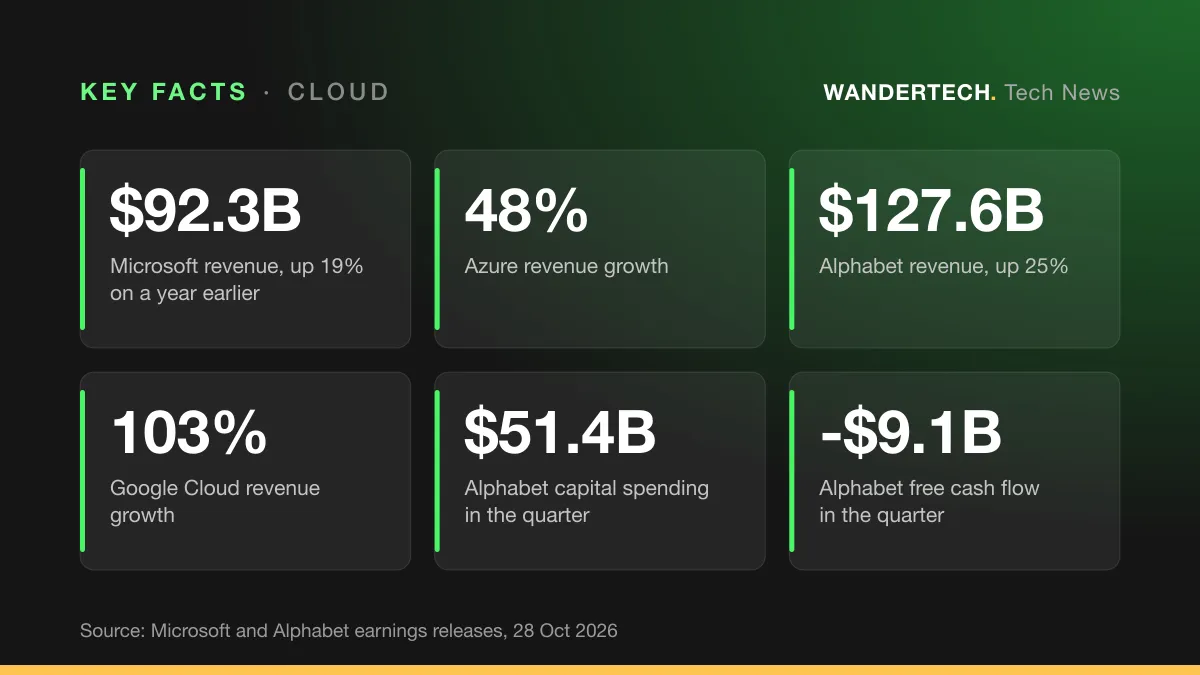
Microsoft reported revenue of $92.3 billion, up 19% on the same quarter a year earlier, with operating income of $45.9 billion (up 21%) and diluted earnings per share of $4.92 on a GAAP basis (up 32%). Microsoft Cloud revenue reached $63.9 billion, up 30%. Azure grew 48%, and commercial remaining performance obligation, which is contracted business not yet recognized as revenue, stood at $677 billion, up 73%. The company also reported results under two newly recast segments, Agents and Infra ($76.8 billion, up 25%) and Devices and Consumer ($15.5 billion, down 3%). Chief financial officer Amy Hood said the results “exceeded expectations across revenue, operating income, and earnings per share,” according to the release.
Alphabet reported revenue of $127.6 billion, up 25%. Google Cloud revenue rose 103% to $30.7 billion, and the unit’s operating income was $11.1 billion, against $3.6 billion a year earlier. Google Services revenue was $96.3 billion, up 11%. Consolidated operating income rose 30% to $40.6 billion, but diluted earnings per share fell to $2.12 from $2.87. Alphabet’s release attributes part of that drop to an $8.7 billion loss on equity securities, which it says reduced diluted earnings per share by $0.55; a year earlier the same line was a $10.7 billion gain. CEO Sundar Pichai said the company is “now on a half-trillion dollar revenue run rate.”
The spending, and the cash
The two companies’ capital spending tells most of the story.
Alphabet spent $51.4 billion on property and equipment in the quarter, and its release reports free cash flow of negative $9.1 billion. The Motley Fool, in its coverage, says capital spending was $24.0 billion a year earlier, which would make the increase more than double. The same article reports that Alphabet’s 2026 spending range of $195 billion to $205 billion is unchanged and that the company expects 2027 spending to “increase significantly”. Investing.com reports operating cash flow of $42.3 billion, which means the quarter’s spending outran the cash the business generated.
Microsoft’s picture was different. Both the Motley Fool and Investing.com put its capital spending, including finance leases, at $45.2 billion, and report free cash flow of about $18.6 billion, which the Motley Fool says is down 27% from a year earlier. In other words, Microsoft is also spending heavily, but it remains well into positive territory on cash.
How the market reacted
Reported share-price moves vary by outlet and by the time they were measured, so we are not giving a single number. Yahoo Finance, republishing a BeInCrypto article, put Alphabet’s after-hours fall at about 7.8%. Investing.com said “nearly 10%”. The Motley Fool cited a decline of around 12%. For Microsoft, the Motley Fool said shares rose after hours, and Investing.com put the gain at about 4%.
Investing.com and Yahoo Finance both note that Alphabet’s revenue came in slightly below what analysts expected, and Yahoo adds that operating income was below its estimate too. Investing.com reports search advertising growth of 12%, far behind the cloud unit. The Motley Fool also says Alphabet’s earnings per share fell well short of expectations even after setting aside the equity loss. Those are the outlets’ characterizations, and we did not check them against the underlying analyst surveys.
Background: why cloud numbers matter so much now
Cloud revenue has become the main scoreboard for AI, because companies that train and run large models rent their computing power from the big cloud providers. When Azure and Google Cloud grow this fast, it indicates that customers are paying for AI workloads, not just talking about them. It also explains why both companies are building capacity at this pace: demand has to be met with servers, chips and data centers that cost billions and take time to bring online.
Why it matters
For the industry. The quarter is a reminder that growth and cash generation are separate questions. A company can double a business and still see its free cash flow turn negative if it spends faster than it earns. Investing.com’s author argues that this gap, not weak cloud results, is what drove the sell-off, and that turning growth into sustainable cash flow is the next test. That is the author’s view, not an established fact.
For software teams (our analysis). If you build on these platforms, two things are worth watching. First, capacity and pricing: the providers are racing to add capacity, which can mean new instance types and new commercial terms, and also pressure to recover the cost. Second, concentration: both companies are betting heavily on AI workloads, and so are many of their customers. A sensible response is to keep architectures portable where it is cheap to do so, track your own AI compute costs per feature, and avoid assuming today’s prices will hold.
Different perspectives and risks
The same results can be read in opposite ways. One reading is that Alphabet’s cloud growth validates its investments and that the cash squeeze is temporary. Another is that it is raising its spending faster than the business can fund it. Microsoft’s more comfortable cash position can be seen as discipline or as a result of having started from a different base. The coverage we read does not settle this, and neither do we.
Some caution on the data itself. Per-quarter figures can be changed by one-off items, such as Alphabet’s equity-securities loss. Share-price numbers move by the minute. And analyst expectations differ between surveys, which is why we have avoided quoting a single consensus figure.
What to watch next
- Amazon’s results, which one roundup we read listed as due the next day, for a third major cloud comparison.
- Capital spending guidance. Alphabet’s 2026 range is unchanged and 2027 is expected to rise significantly, according to the coverage we read. Further updates will show whether that holds.
- Free cash flow at both companies over the next two quarters.
- Debt and financing. The Motley Fool reports that Alphabet raised money through senior notes and stock sales and that its long-term debt has grown sharply, which makes its financing choices worth tracking.
The bottom line
Cloud growth is no longer the question. Microsoft and Alphabet both showed that AI demand is arriving in the numbers. The open question is how the largest builders of AI capacity pay for it, and the market’s different reactions on the same night suggest investors are now paying attention to that. For everyone else, the practical message is simple: the infrastructure you rent is being built on a very large bet, so plan for both abundance and change.
Sources
- Microsoft: Microsoft announces first quarter results (Microsoft, 28 October 2026; primary source)
- Alphabet Form 8-K, Q3 2026 earnings release (Alphabet via SEC; primary source)
- The Motley Fool: Microsoft and Alphabet Just Reported Earnings, Putting the AI Boom to the Test
- Investing.com: Google Cloud Doubled: Why Did Alphabet Stock Fall 10%?
- Yahoo Finance (BeInCrypto): Alphabet Stock Falls 8% Even as Cloud Sales Double