SK hynix Posts a Record Quarter as AI Keeps Memory in Short Supply
SK hynix's revenue passed 100 trillion won for the first time, with an operating margin near 80%. What it reported, what it says about HBM4 and supply, and what to treat with caution.
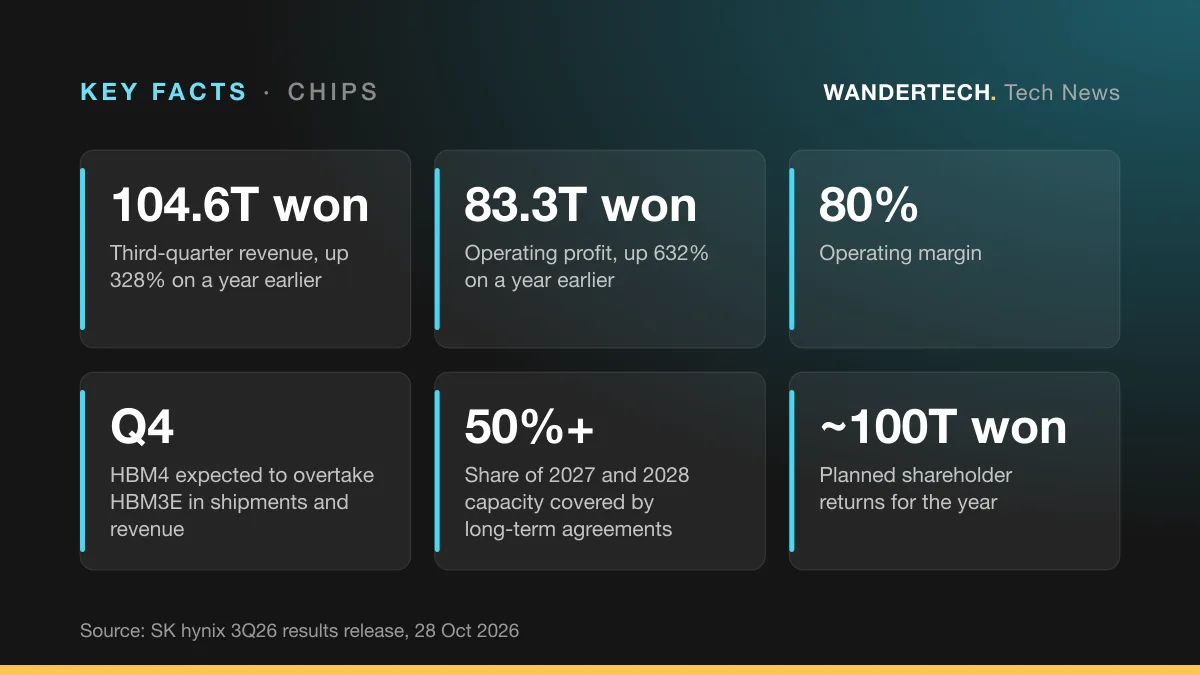
Memory chips for AI are in short supply, according to SK hynix, and the company has just reported what that is worth. It said its third-quarter revenue passed 100 trillion won for the first time and that its operating profit was about 83 trillion won, a margin of roughly 80%.
A note on method: figures come from SK hynix’s own results release, its earnings call as transcribed by Investing.com, and reporting by the Korea Herald and Korea Times. The company’s figures are preliminary and unaudited. Analysis is labelled as ours. This post is informational and is not financial advice.
What happened
SK hynix announced its third-quarter 2026 results, for the July to September period, on 28 October Korea time. According to the company’s release:
- Revenue was 104.6155 trillion won, up 32% from the previous quarter and 328% from a year earlier. It is the first quarter above 100 trillion won.
- Operating profit was 83.3338 trillion won, up 38% on the quarter and 632% on the year, for an operating margin of 80%. The Korea Herald reports the margin as 79.7%, against 76.3% in the previous quarter.
- Net profit was 39.7756 trillion won, which is lower than the previous quarter’s figure in the release’s table. The release does not explain why. On the earnings call, as transcribed by Investing.com, chief financial officer Kim Woo-hyun attributed non-operating losses of about 32.6 trillion won mainly to an 11.6 trillion won currency loss and a 22.9 trillion won valuation loss on investment assets.
Both the Korea Herald and the Korea Times say operating profit beat expectations. The Korea Herald puts the expectation at about 77 trillion won but does not say whose estimate that is, and the Korea Times gives no figure.
The memory story: HBM4
The headline product is high-bandwidth memory, or HBM, stacks of memory chips placed beside AI processors. SK hynix says HBM4, its newest generation, entered full-scale mass production and shipments in the third quarter and that it expects HBM4 to pass the previous generation, HBM3E, in both shipment volume and revenue in the fourth quarter. The Korea Herald adds that Kim Ki-tae, the company’s head of HBM sales and marketing, said yields exceeded targets.
Server memory also contributed. The release says sales of server DDR5 rose significantly, and the call transcript describes average selling prices for DRAM rising in the high-20% range from the previous quarter.
What the company says about supply
SK hynix says memory supply will stay below demand through 2030, because the most advanced manufacturing is difficult and new factories take a long time to build. Several specifics stand out:
- Long-term agreements with 14 major customers cover more than half of the company’s 2027 and 2028 production capacity.
- On the call, chief executive Kwak Noh-jung said DRAM and HBM volumes through 2029 are effectively sold out. According to the Korea Herald, that counts signed agreements and also demand still under discussion, which the company calls highly likely to turn into orders. The Korea Herald also reports Kim Ki-tae saying customers are asking for more than twice the volume the company can supply.
- Investment is expected to rise significantly in 2027 as the first phase of the Yongin site enters full operation, though the release says the scale and timing will be adjusted flexibly.
Shareholder returns
The company plans to return about 100 trillion won to shareholders for 2026, including at least 30 trillion won in cash dividends and at least 60 trillion won in share buybacks and cancellations. The third-quarter dividend is 20,000 won per share, which includes a 10,000 won special payment tied to gains from its Kioxia investment, according to the release. It also announced a 20 trillion won buyback, of which, per the release, about half will be cancelled and about half goes to employee compensation and sits outside the shareholder-return total.
Why it matters
For the AI industry. A company that supplies a critical component and says demand exceeds supply into 2030 has unusual pricing power. Memory is also one of the limits on how quickly AI capacity can be built. When it is scarce, it influences what cloud providers can add and what they charge.
For everyone buying hardware (our analysis). Servers, and eventually consumer devices, can get more expensive when memory is in short supply, and lead times can lengthen. That is a reasonable expectation, but it is not something this release states directly.
For software teams (our analysis). If your product depends on AI inference, the cost and availability of the hardware underneath it are not under your control. It is worth measuring your own compute usage per feature and having a plan if the cost per request rises.
Caveats and different perspectives
- These are the company’s own figures and forecasts. We found no independent verification of the outlook in the coverage we read. The Korea Herald reports that the company disputes concerns that the AI boom is peaking.
- “Sold out” is not the same as “contracted”. As noted above, it includes demand still being negotiated.
- Memory has historically gone through cycles of shortage and surplus. That is general background rather than something in these sources, but it is the reason some observers treat long-range supply forecasts with caution.
- Net profit fell even as operating profit rose. The call attributed this to currency and investment valuation losses, not to the core business.
- Reported dollar figures differ across outlets, because of exchange rates used. We have given won figures, which are the company’s.
What to watch next
- Whether HBM4 overtakes HBM3E in the fourth quarter, as the company expects.
- Competitors’ updates, which will show whether the shortage is specific to SK hynix or industry-wide.
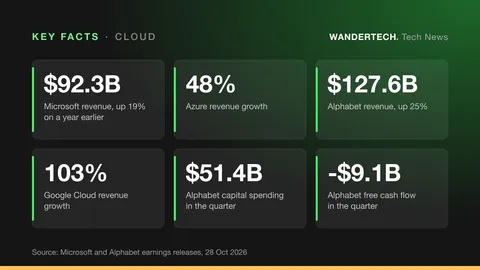
- Customers’ capital spending plans, since that is where demand for this memory originates. The same week, Microsoft and Alphabet reported spending of $45.2 billion (including finance leases) and $51.4 billion in a single quarter, respectively.
- The fourth-quarter report, for the first full picture of HBM4’s effect on revenue.
The bottom line
SK hynix’s quarter is a snapshot of where the AI build-out is limited: not by ideas, but by memory chips and the factories that make them. The company says the squeeze lasts for years. That claim deserves attention and some healthy scepticism, and the results to come will test it.
Sources
- SK hynix: SK hynix Announces 3Q26 Financial Results (company release via PR Newswire; primary source)
- Investing.com: Earnings call transcript: SK hynix posts record Q3 2026 results (transcript, noted by the site as produced with AI support and editor review)
- The Korea Herald: SK hynix’s AI memory ‘sold out’ through 2029 as profits soar
- The Korea Times: SK hynix logs record Q3 operating profit of $62.8 bil.