Apple Finally Puts a Touchscreen on the Mac: What the New MacBook Pro Means
On October 28 Apple unveiled a MacBook Pro with a touch-enabled OLED display. What was announced, what is still unproven, and what it means for people who build software.
For well over a decade, Apple’s senior leaders explained why laptops should not have touchscreens. On 28 October 2026 the company shipped one anyway. Its new MacBook Pro has a touch-enabled OLED display, a Dynamic Island where the notch used to be, and a price list that starts at $2,899.
It was the launch that drew the most attention in the past day, and it is worth unpacking. It is a hardware story, but it is also a story about how software gets built for a new kind of input. Here is what Apple announced, what the reporting says, and what we think it means for teams that make apps and websites.
A note on method: the facts below come from Apple’s own announcement and from independent coverage we read in full. Where outlets disagree, we say so. Sections marked as analysis are our opinion, not reporting.
What happened
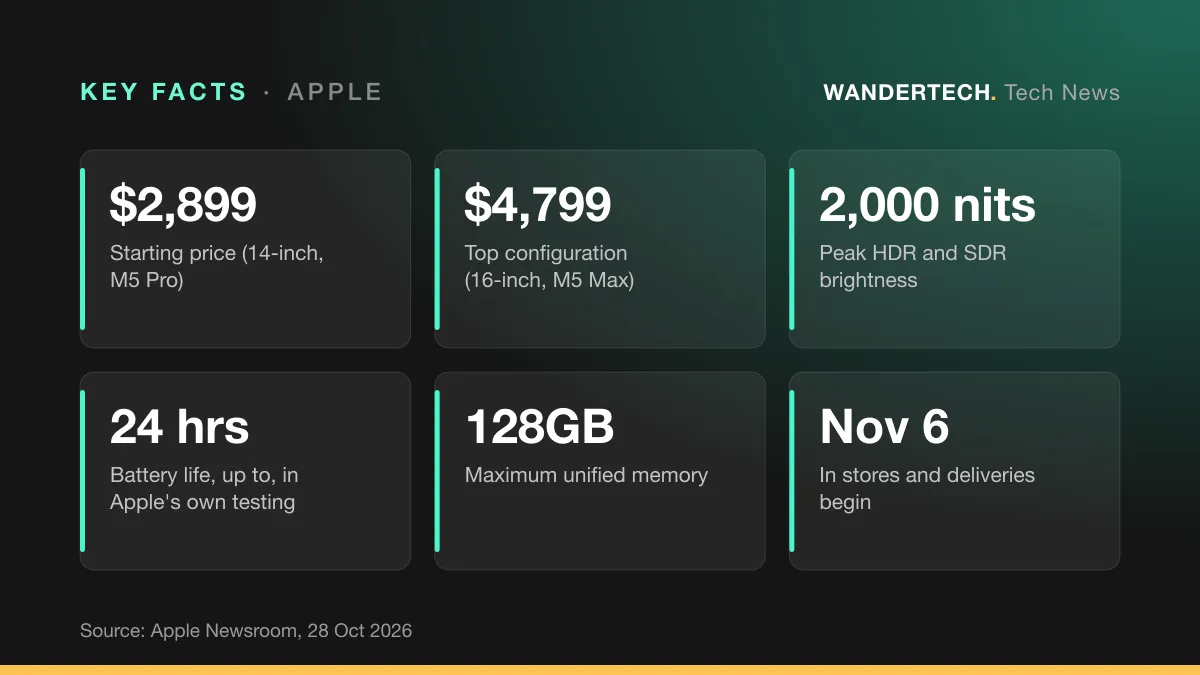
According to Apple’s newsroom release, the company introduced the MacBook Pro with PROLED XDR Display on 28 October. It comes in 14-inch and 16-inch sizes and uses the M5 Pro or M5 Max chip. Apple lists configurations of up to 128GB of unified memory and up to 16TB of storage.
The display is the headline. Apple describes it as a tandem OLED panel with up to 2,000 nits of peak brightness in both HDR and SDR, a 10,000,000:1 contrast ratio, and adaptive refresh from 10Hz to 120Hz. The touch sensor is built into the panel itself rather than added as a layer on top. Apple says this is the first time a Mac has had touch. The Dynamic Island, borrowed from the iPhone, replaces the notch and hosts things like Spotlight and Live Activities.
Apple also says the laptops get up to 24 hours of battery life, a figure it attributes to its own testing in September 2026. The 14-inch model weighs about 3 pounds and the 16-inch about 4 pounds, which Apple says makes the larger one 0.7 pounds lighter than before.
US prices, per Apple:
| Model | Chip | Price |
|---|---|---|
| 14-inch | M5 Pro | $2,899 |
| 16-inch | M5 Pro | $3,399 |
| 14-inch | M5 Max | $4,499 |
| 16-inch | M5 Max | $4,799 |
Apple says the machines arrive in stores and from resellers on 6 November. On the pre-order date the sources disagree. Apple’s release and the other coverage we read say pre-orders opened on 28 October, while TechCrunch reported 30 October. We have gone with Apple’s own date, but it is worth confirming before you plan a purchase around it.
On the software side, Apple says the machines run macOS 27, which it calls “Golden Gate,” and that many existing apps work with touch right away. It names Microsoft Office, Adobe Lightroom and DaVinci Resolve among the third-party apps with touch support, with some arriving later this year. Johny Srouji, Apple’s chief hardware officer, called the product “a monumental step forward for the Mac” and said the display is the best on any laptop, which is Apple’s own claim.
One more detail avoids confusion. The day before, Apple announced a separate 14-inch MacBook Pro with the M6 chip, starting at $1,999, according to TechCrunch and MIXED. MIXED reports that this model keeps a mini-LED screen, so the touch machines are a distinct line rather than a replacement.
Background: a long reversal
The reason this made headlines is the history. Fox 10, in a report that includes information from Reuters, recounts that Steve Jobs dismissed laptop touchscreens as ergonomically poor in 2010, and that Tim Cook in 2012 compared merging a laptop and a tablet to merging a toaster and a refrigerator. TechCrunch gives a similar account of Jobs’s view.
The argument reached its clearest form in 2016. MacRumors reported at the time that Phil Schiller told the publication Backchannel that Apple had tested touch-screen Macs in its labs and decided against them. His reasoning was that touch would be awkward on a desktop where the screen sits far from your hands, and that touch on a laptop alone would split the Mac lineup into two kinds of machine.
Apple’s alternative that year was the Touch Bar, a thin touch strip above the keyboard. TechCrunch notes it was later removed. Meanwhile, as Fox 10 points out, Windows laptops have offered touchscreens for more than a decade.
Why it matters
For buyers. The practical question is who this machine is for. In our view, the prices put it firmly at the professional end of the market, and the features Apple stresses are creative: direct manipulation in photo, video and 3D tools. For anyone who has wished they could pinch, drag or scroll on a Mac the way they do on an iPad, this removes a long-standing gap.
For the industry. A company with Apple’s influence adopting touch tends to change what the rest of the market treats as normal. Analyst Anshel Sag of Moor Insights & Strategy, quoted in the Fox 10 report, said some things are “purely inevitable.” Whether or not you agree, a touch Mac makes touch a mainstream expectation for premium laptops, not a Windows-only feature.
For software teams (our analysis). This is the part we care about most. Apple says many existing Mac apps work with touch right away. MIXED reports that macOS turns touches into clicks, which is why existing apps can work at once. But “works” and “feels right” are different bars. A button sized for a mouse pointer can be frustrating under a fingertip. Hover menus and tiny close icons assume a precision that fingers don’t have. Teams with Mac apps, and anyone whose web product is used in Safari on a Mac, now have a reason to audit tap target sizes and interactions that depend on hover. We would expect the better-designed products to treat this as a polish opportunity.
Different perspectives and risks
Not everyone cares about the touchscreen. Per the Fox 10 report, podcast host Jason Calacanis wrote on X that most people want more memory and faster processors to run AI models locally, not a new input method. It is a fair reminder that a flashy feature is not the same as the feature most buyers prioritize.
There are also open questions, which we can’t resolve from what has been published so far:
- Independent testing is thin. Most of the figures above, including brightness, contrast and the 24-hour battery claim, come from Apple. Its claim that this is the best laptop display is a marketing statement, not a measured result. We did not find independent measurements in the coverage we read, and proper reviews should follow once units ship.
- Software quality is unproven. Nothing we read describes how touch performs over weeks of daily use. Apple’s list of third-party apps with touch support includes updates that have not yet shipped.
- Pricing may limit reach. The cheapest touch model costs $2,899, so the audience at launch is narrower than for Apple’s other laptops.
- Conflicting details exist. The pre-order date discrepancy above is small, but it is a reminder to check the official product page.
What to watch next
- First independent reviews and teardowns, likely around the 6 November on-sale date, which will test the battery, brightness and touch claims.
- Third-party app updates. Apple says several will arrive later this year, and the speed of adoption will show how seriously developers take the platform.
- Apple Creator Studio. Apple says its creative-apps subscription gets a free update in November, and that its apps include touch support.
- How the two MacBook Pro lines coexist. Reporting so far describes the touch models as separate from the M6 model announced a day earlier, and it’s not yet clear how Apple will position them over time.
The bottom line
A product category Apple’s leaders spent years dismissing now sits at the top of its laptop lineup. The change is real, but the verdict isn’t in. Specifications and a launch event tell us what Apple intends. Reviews, developer support and months of daily use will tell us whether touch on the Mac is a genuine step forward or an expensive extra. For software teams, the useful response doesn’t depend on the answer: check how your product behaves under a finger, and fix what doesn’t.
This post is informational. It is not purchasing or investment advice.
Sources
- Apple Newsroom: Apple unveils groundbreaking MacBook Pro with PROLED XDR Display (Apple, 28 October 2026; primary source)
- TechCrunch: Apple launches its new touchscreen MacBook Pro
- MIXED: Apple’s Pro and Tell event: touchscreen OLED MacBook Pro is now official
- FOX 10 Phoenix / LiveNOW from FOX: Apple unveils 1st touchscreen MacBook Pro after years of resistance (includes information from Reuters)
- MacRumors: Apple Expected to Announce MacBook Pro With Touchscreen Tomorrow (pre-announcement context)
- MacRumors: Phil Schiller Says Apple Tested and Rejected Touch Screen Macs (2016 background)