TSMC Reports Another Record Quarter as Its 2nm Chips Begin to Show Up in the Numbers
TSMC's net income rose 68.7% to NT$763 billion in the third quarter, and 2nm chips reached 8% of wafer revenue. What the company reported and what its guidance says about the next quarter.
If one company shows how much of the world’s advanced computing is being built, it is TSMC, the Taiwanese manufacturer that makes chips for many of the biggest names in AI and consumer electronics. On 15 October 2026 it reported its third-quarter results, and the headline was another jump in profit, along with the first real appearance of its newest manufacturing process in the revenue mix.
A note on method: figures come from TSMC’s own earnings release, which it filed with the US Securities and Exchange Commission, and from two independent summaries, TrendForce and Value The Markets. Value The Markets notes the third-quarter figures had not yet been approved by TSMC’s board. This post is informational and is not financial advice.
What happened
TSMC’s results for the quarter ended 30 September 2026, per its release:
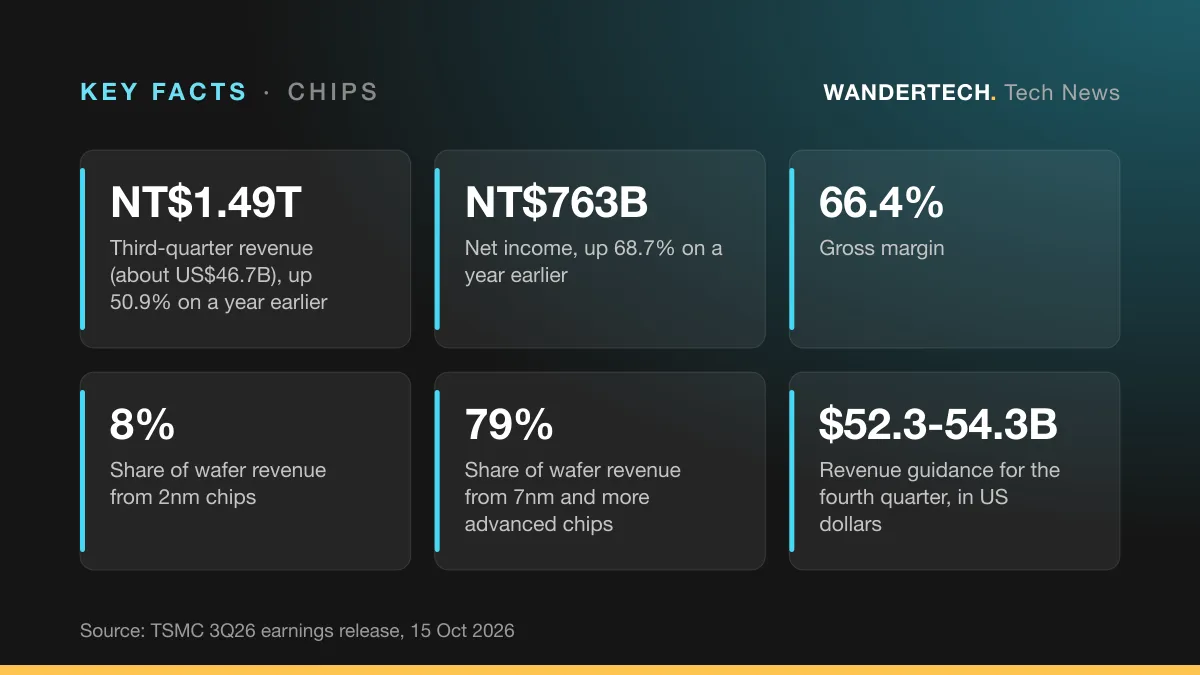
- Revenue was NT$1,494.24 billion, about US$46.72 billion. That is up 50.9% on the same quarter a year earlier and 17.6% on the previous quarter in Taiwan dollars. In US dollars, growth was 41.2% on the year and 16.2% on the quarter. The gap between the two sets of figures reflects exchange rates.
- Net income was NT$763.06 billion, up 68.7% on the year and 8.0% on the quarter. TrendForce describes this as a record.
- Earnings per share were NT$29.43, or US$4.60 per American depositary receipt unit.
- Margins: gross margin was 66.4%, operating margin 58.7% and net profit margin 51.1%.
The mix: where the 2nm chips show up
TSMC reports how much of its wafer revenue comes from each manufacturing generation. In the third quarter, 2nm chips, the newest, made up 8% of wafer revenue, up from 3% the quarter before, according to TrendForce. The rest of the mix was 3nm at 33%, 5nm at 28% and 7nm at 10%, so that 7nm and more advanced technologies together made up 79% of wafer revenue, per the release.
The numbers refer to the size class of the process, and smaller generally means more advanced. The practical point is that the newest generation is now a measurable part of the business, not just an announcement.
Guidance for the next quarter
For the fourth quarter TSMC guided to:
- revenue of US$52.3 billion to US$54.3 billion,
- a gross margin of 65% to 67%,
- an operating margin of 56.5% to 58.5%,
assuming an exchange rate of 31.8 Taiwan dollars to the US dollar. Value The Markets calculates that the midpoint of the revenue range is about 14% above the third quarter in US dollars.
Chief financial officer Wendell Huang said in the release that the third quarter was “supported by strong demand for our leading-edge process technologies,” and that the fourth quarter should be supported by continued demand, including the steep ramp-up of 2nm.
Background
TSMC is a foundry, meaning it manufactures chips designed by other companies. Many of the processors used for AI training and inference are made by TSMC, which is one reason why its results are watched as a gauge of demand across the chip industry. For example, Microsoft’s Maia 300, announced three days earlier, is designed to use TSMC’s N2P process for its compute chiplets.
Why it matters
For the chip industry (our analysis). Revenue growth of 50.9% in a year, at TSMC’s scale, points to strong demand for its chips. The change in the node mix suggests customers are moving to the newer processes.
For analysts and investors (informational only). Margins are a key thing to watch because new processes are typically more expensive to ramp. TrendForce reports that JPMorgan’s head of Taiwan research, Gokul Hariharan, expected strong utilization of 3nm and 5nm capacity and foundry price increases to offset margin pressure from the 2nm ramp and overseas factories. That is an analyst’s expectation as reported by TrendForce, not a finding in the earnings release.
For software teams (our analysis). Few product teams buy chips directly, but the cost and availability of cloud AI services depends on what comes out of foundries like this one. A foundry that is growing this fast and guiding higher is one indicator of how much chip capacity is being added. It does not, on its own, say anything about what cloud AI services will cost, and this release does not address that.
Caveats
- The figures are preliminary. Value The Markets notes that the third-quarter results had not yet been approved by the board.
- Guidance depends on currency. TSMC’s margin guidance assumes a fixed exchange rate, so movements in the Taiwan dollar would change the reported numbers.
- We followed the company’s own release for every reported figure.
- We did not find capital spending figures in the sources we opened in full, so we have not included any.
What to watch next
- The 2nm share in the fourth quarter, which will show how quickly it ramps.
- Gross margin against the 65% to 67% guidance.
- Customers’ spending plans, because those orders drive TSMC’s revenue.
The bottom line
TSMC’s quarter was a record on almost every measure it reports, and its guidance points to more growth. The more interesting change is inside the numbers: the 2nm generation has moved from roadmap to revenue.