China Proposes Export Controls on 40 Technologies, 23 of Them in AI
Beijing published a draft that would add AI models, agents and chip-design know-how to its export control catalogue. What the draft says, what is still unclear, and what to watch before it is final.
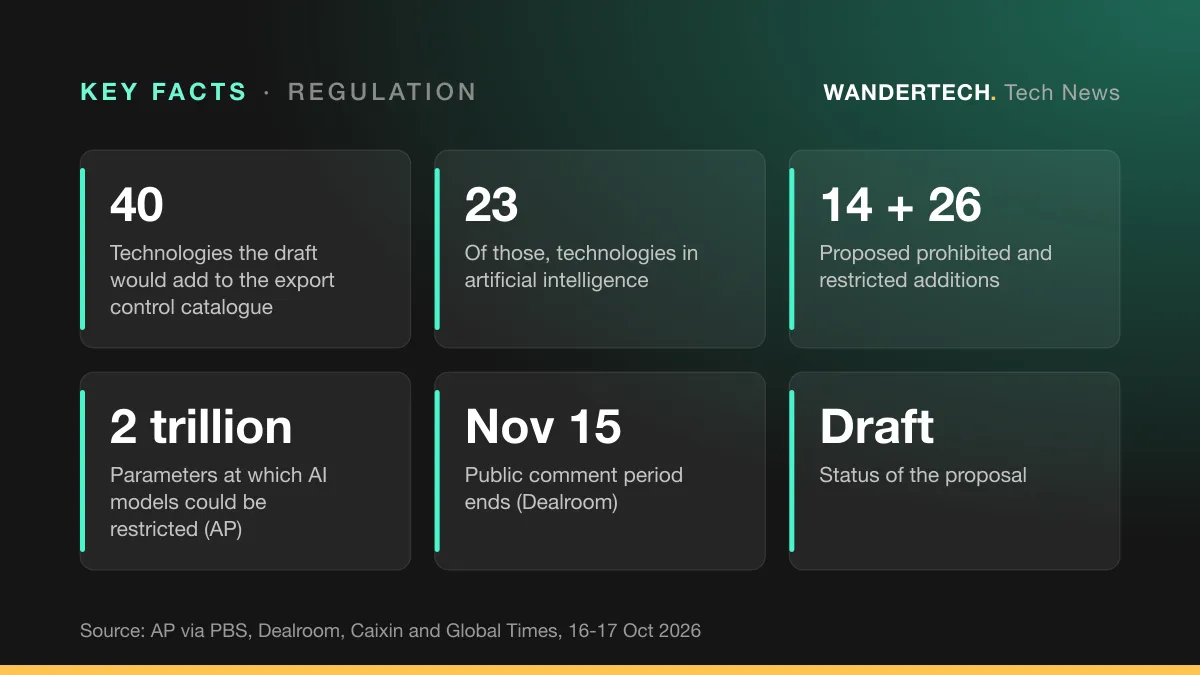
China has published a draft that would put some of its artificial intelligence technology under export control. On 16 October 2026 two government ministries proposed adding 40 technologies, 23 of them in AI, to the catalogue of technologies that cannot be exported or can only be exported with permission. The proposal is not final, and several important details are not yet clear.
A note on method: we did not open the ministries’ own text. The facts below come from reporting by the Associated Press (via PBS), Caixin and Dealroom, and from the commerce ministry’s statements as reported by the state-run Global Times. Where these differ or are thin, we say so. Analysis is labelled as ours.
What happened
According to AP’s report, China’s Ministry of Commerce and Ministry of Science and Technology jointly published a draft revision of the export catalogue. The draft covers 40 technologies:
- AI: 23 technologies, ranging from advanced large models to AI agents.
- Solar: 12 technologies, including those for making polysilicon.
- Biomedicine: 5 technologies, including cell and gene therapy.
AP also reports that the draft covers several chip design technologies, including some for AI processing and memory chips, without saying how many. Dealroom, which cites the ministries’ announcement and several other outlets, reports that the 40 would be split into 14 prohibited items and 26 restricted ones. Caixin gives the same split of 14 bans and 26 that would require export licenses.
What the AI provisions say
AP reports these AI provisions in the draft:
- Core technologies for large models trained on sensitive national data would be prohibited from export.
- AI agents designed for highly sensitive settings, such as national defence and critical information infrastructure, would be prohibited.
- AI models with 2 trillion or more parameters, or with certain world-leading capabilities, could be restricted.
Dealroom adds, citing secondary reporting, that model weights and source code would be restricted above performance thresholds and that those thresholds are provisional. It also reports that technologies already public through open source or published papers are excluded. The ministry’s spokesperson, as reported by Global Times, said the measures aim to keep AI “safe and controllable while encouraging open-source development, cooperation and sharing,” and that exports tied to open-source AI development would be eligible for automatic licensing on registration.
Process and timing
Two further points come from Dealroom and Global Times:
- Interim registration. A temporary pre-export registration requirement took effect the same day. Dealroom reports that it also covers unfinished deals.
- Consultation. Dealroom reports public comments are open through 15 November 2026. AP’s report gave no adoption date, consultation period or effective date.
The stated reasons
The commerce ministry called the measures “necessary” in AP’s account, and said they aim to reinforce security, prevent misuse and keep AI under human control. Global Times reports the spokesperson pointing to risks from technologies that could let AI autonomously generate and modify malicious code and attack critical infrastructure, national defence or core government systems. AP also quotes Lian Jye Su of the research firm Omdia, who sees the move as a response to Western sovereignty rules and a way to better regulate access to Chinese technology, and Gary Ng of Natixis, who says access to technology is fragmenting alongside trade and investment.
Background
Export control catalogues are lists of technologies that need government permission, or are barred, before they can be transferred abroad, whether by sale, licence or transfer of ownership. The United States and other countries have used export controls on advanced chips and related equipment. Dealroom reports that Beijing frames the rewrite as aligning with practices other major economies already use, which is the government’s own framing.
Why it matters
For AI companies and researchers (our analysis). If adopted, the draft could affect partnerships, licensing and technology transfers involving Chinese AI labs. Dealroom’s own view, which is analysis and not reporting, is that this is a “sticky governance signal” for anyone partnering with Chinese labs or buying Chinese solar or biotech IP, because deals that used to be informal would have to be registered.
For software teams (our analysis). Most teams do not export AI technology in the sense the catalogue means. But many depend on open-weight models, hosted model APIs or Chinese-developed tools. The reporting we read says open-source releases would be outside the controls, and it does not settle how hosted services would be treated. The practical step is to know which models and vendors your product depends on and where they come from, so you can respond if the rules change.
What is unclear
Several details are not clear from the reporting we read:
- Which of the 40 items would be banned and which restricted, and the full list of chip technologies.
- How the draft defines “world-leading capabilities,” “sensitive national data” and “highly sensitive environments.”
- Whether specific, widely used Chinese models would be affected. As reported, the proposal names no models.
- How hosted services would be treated. The sources we opened do not address API access.
- When anything would take effect, and how it would be enforced.
What to watch next
- The consultation period, which Dealroom reports ends on 15 November.
- The final text, especially the definitions and thresholds.
- Reactions from other governments and from companies that rely on Chinese AI technology.
- How the interim registration works in practice for pending deals.
The bottom line
China is moving to treat parts of its AI stack, from models to agents to chip design, as technologies that need an export permit. The draft is a proposal, the definitions are open, and the reporting so far comes mainly through secondary sources. The sensible reading for now is that a new rulebook is being written and that its details will matter more than its headline numbers.
Sources
- PBS NewsHour (Associated Press): China says it will curb tech exports, including AI, citing national security risks
- Dealroom News: China drafts export curbs on 40 AI, solar and biotech technologies (cites the ministries’ announcement and other outlets)
- Caixin Global: China Proposes Export Curbs on AI and Solar Technology
- Global Times: China’s proposed AI tech export controls aim to ensure safety, encourage open-source devt and sharing: commerce ministry (state-run outlet; reflects the government’s framing)