Microsoft Unveils Maia 300, the Next Generation of Its In-House AI Chip
Microsoft says its third-generation Maia chip arrives in 2027 and will become its main system for running AI models. What it announced, what is only a claim, and why it matters to cloud customers.
The companies that run AI at the largest scale are no longer content to buy all of their processors from one supplier. On 12 October 2026 Microsoft added to that trend with Maia 300, the third generation of a chip it designs itself, and said it plans to make the Maia family the main system that runs AI models across its own products.
A note on method: facts below come from Microsoft’s own announcement and from independent reports by AFP and Yahoo Finance. Nearly every performance number is Microsoft’s own claim, and we say so each time. Analysis is labelled as ours.
What happened
Microsoft announced Maia 300 in a post on its official blog by Scott Guthrie, the executive vice president who leads its cloud and AI group, and Yahoo Finance reports the reveal took place at the OCP Global Summit in San Jose. According to the blog post:
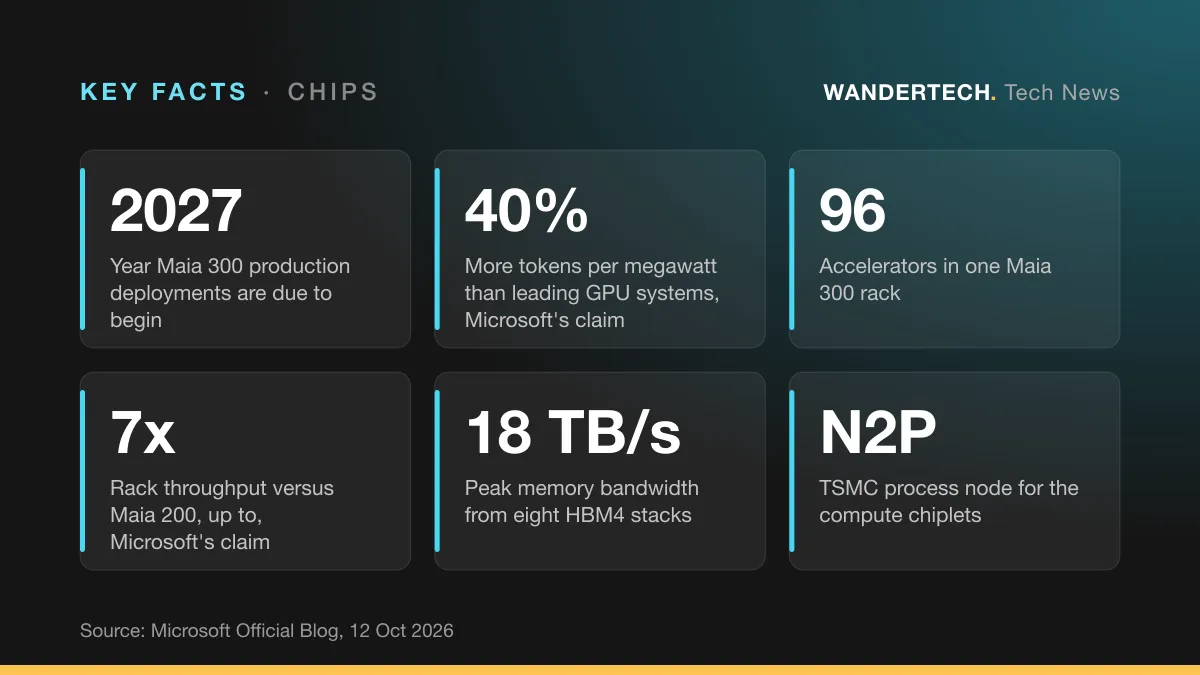
- Timing. Maia 300 production deployments begin in 2027. Its predecessor, Maia 200, is already in production.
- The chip. Each Maia 300 has eight stacks of HBM4 memory providing 18.0 terabytes per second of peak memory bandwidth, with a power rating (TDP) of 950 watts. The compute chiplets are built on TSMC’s N2P manufacturing process.
- The rack. A rack holds 96 accelerators within a 167-kilowatt power envelope and carries 27.6 terabytes of high-bandwidth memory.
- Scale. Microsoft plans to scale the Maia system to multi-gigawatt deployments starting in 2027, with Maia becoming the primary inference system for its products and services. Inference is the stage where a trained model answers requests, as opposed to training.
What is a claim, and what is not
The specifications above are descriptions of the design. The performance statements are projections from Microsoft, and neither AFP nor Yahoo Finance reported independent benchmarks:
- Microsoft expects Maia 300 to deliver 40% more tokens per megawatt than “leading GPU-based systems,” a comparison it does not name. A token is the small chunk of text a model reads or writes.
- Microsoft says a full 96-accelerator configuration delivers up to seven times the rack-scale token throughput of Maia 200.
- For Maia 200, Microsoft says it provides up to 1.7 times more tokens per watt than leading GPU infrastructure for built-in AI features in Teams, Copilot and Cowork, a narrower comparison than a general one.
Where Maia is used today
Per the blog post, Maia 200 is deployed in the United States, Europe and Australia and serves production workloads including Microsoft Copilot and the work of Microsoft’s MAI team, which develops the company’s own models. Microsoft says it also runs OpenAI models and leading open-source model families. GitHub Copilot and Microsoft Foundry are expected to run on Maia 200 by the end of the year.
Background: why build your own chip
Large cloud companies spend heavily on AI processors, and most of those chips come from a small number of suppliers. Yahoo Finance’s reporter notes that Nvidia regularly earns more than half of its quarterly revenue from the biggest cloud providers, which makes those customers’ custom chips a possible risk to it. The same article points out that Amazon and Google already rent out their own custom chips to outside customers, and that Amazon is reportedly weighing selling chips for customers’ own data centers.
Yahoo Finance’s reporter also says hyperscalers will probably keep buying Nvidia chips for different workloads, and that Nvidia’s most in-demand processors remain essential for now. Microsoft’s own announcement describes Maia as the primary inference system for its products and services.
Why it matters
For Microsoft (our analysis). A company that makes its own chip can tune hardware and software together, and it gains some control over cost and supply. Microsoft’s argument rests on efficiency: if its figures hold up, each unit of electricity would produce more AI output. That would matter because power, not only chips, is a limit on building data centers.
For cloud customers (our analysis). Most customers will never choose a Maia chip directly. They will see it as a service, a model endpoint or a price. If custom silicon lowers Microsoft’s cost per token, that could show up in pricing or capacity over time, but nothing in this announcement promises it.
For software teams (our analysis). Treat hardware as an implementation detail you may not control. Build against model APIs and abstractions rather than chip-specific features unless you have a clear reason, and measure cost and latency per request on the platform you actually use.
Risks and open questions
- Everything performance-related is Microsoft’s own projection. Independent testing will be the real check, and none had been reported at the time of writing.
- Timelines can slip. Production deployments are due in 2027, so the chip’s real-world record is still ahead of it.
- Supply still depends on others. The design relies on TSMC’s manufacturing and on HBM4 memory, so it depends on the supply of both.
- Naming and units differ slightly across Microsoft’s own materials, such as per megawatt versus per watt, so compare like with like when quoting.
What to watch next
- Independent benchmarks and any customer-visible effect on Azure pricing or availability.
- Maia 200 rollout. Microsoft says GitHub Copilot and Microsoft Foundry are due on it by year-end.
- Responses from competitors, since Amazon and Google already offer custom chips to customers.
The bottom line
Maia 300 is a statement of direction more than a finished product: Microsoft intends to run more of its own AI on its own silicon, at very large scale, from 2027. The numbers it gives are impressive if they hold. Until someone else measures them, they are claims.
Sources
- Microsoft Official Blog: Microsoft to expand Azure Maia system to multi-gigawatt deployments (Scott Guthrie, 12 October 2026; primary source)
- Tech Xplore (AFP): Microsoft bets on homegrown AI chip to challenge Nvidia
- Yahoo Finance: Microsoft reveals Maia 300 AI chip as it works to reduce dependence on Nvidia, AMD